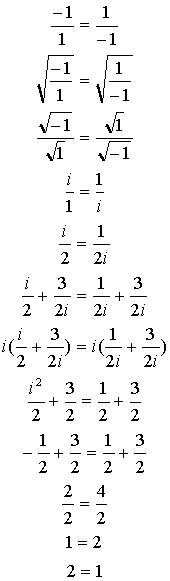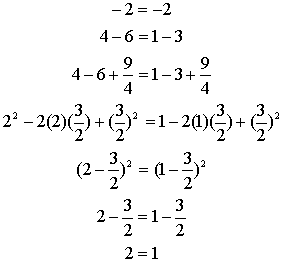
1. 2=1 problem: (Part 1)
2. 2=1 problem: (Part 2: Complex number)
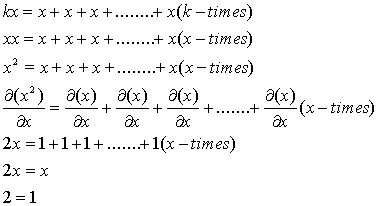
3. 2=1 problem: (Part 3: derivatives)
4. Infinite Speed?
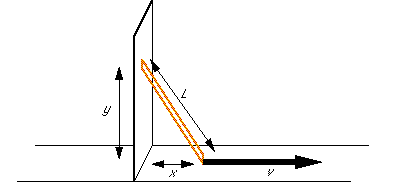
As shown, let x denote the horizontal distance from the bottom of the ladder to the wall, at time t.
As shown, let y denote the height of the top of the ladder from the ground, at time t.
Since the ladder, the ground, and the wall form a right triangle, x2+y2=L2
Therefore, 
Differentiating, and letting x' and y' (respectively) denote the derivatives of x and y with respect to t, we get that
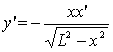
Since the bottom of the ladder is being pulled with constant speed v, we have x' = v, and therefore
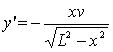
As x approaches L, the numerator in this expression for y' approaches -Lv which is nonzero, while the denominator approaches zero.
Therefore, y' approaches  as
x approaches L. In other words, the top of the ladder is falling
infinitely fast by the time the bottom has been pulled a distance L away
from the wall.
as
x approaches L. In other words, the top of the ladder is falling
infinitely fast by the time the bottom has been pulled a distance L away
from the wall.
Wilson
--
[email protected]
[email protected]
[email protected]
ICQ 2417224